Convection
Convective heat transfer is the transport of thermal energy due to bulk motion of a fluid (a liquid or a gas) over a surface.
- \( q_{1-2} \) = rate of heat flow from 1 (hotter) to 2 (colder) \( [W] \)
- \( A \) = surface area normal to the direction of heat flow \( [m^2] \)
- \( T_1 \) = temperature of 1 (e.g., system) \( [K] \)
- \( T_2 \) = temperature of 2 (e.g., surroundings) \( [K] \)
- \( h \) = convective heat transfer coefficient (which always includes the effect of conduction in the fluid) \( [\frac{W}{m^2 K}] \)
The convective heat transfer coefficient \( h \) is a proportionality constant between the temperature difference and heat flux. Note that it is not a material property, but depends on geometry, flow conditions, and fluid properties, which can all be measured experimentally.
Convection can be free (driven by differences in density) or forced (driven by external forces such as pumps and fans).
Heads Up!
Learn how to calculate the convective heat transfer coefficient below.
Convective Heat Transfer in Biological Systems
Convective heat transfer occurs in a variety of biological systems, where fluid motion transports heat from one location to another. Examples of convection in biological systems include:
- Blood flow redistributing heat throughout the body. Blood carries heat away from metabolically active organs, helping to maintain a stable internal body temperature.
- Cooling yourself with a fan. Moving air carries heat away from the skin faster than still air.
- Water convection in lakes helping to redistribute nutrients. Water at different temperatures moves and mixes, which redistributes both thermal energy and dissolved nutrients through the ecosystem.
- Vasodilation increasing heat loss. The body can increase blood flow near the skin by dilating peripheral blood vessels. As a result, vasodilation brings heat from the body core to the surface, where it can be more easily transferred to the environment through convection.
- A penguin's use of countercurrent heat exchange to reduce heat loss. Warm arterial blood flowing toward their feet passes alongside colder venous blood returning to the body, which allows for heat to transfer between the two blood vessels. This helps penguins conserve heat in cold environments by limiting heat loss.
Boundary Layers
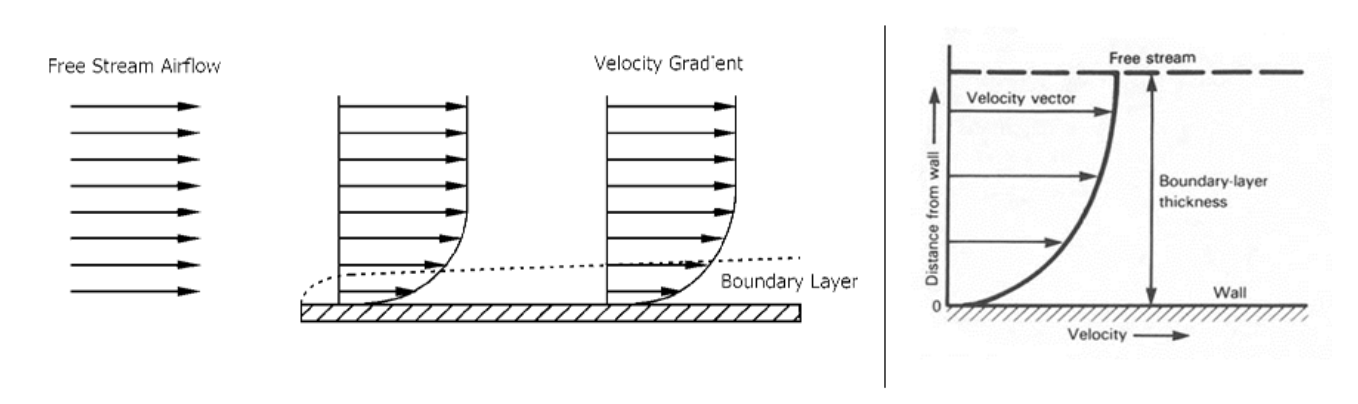
A boundary layer is a thin region of fluid in contact with a solid surface where properties such as velocity or temperature rapidly change. Outside this region, the fluid is affected significantly less by the surface, so gradients are relatively small. In convection problems, it’s important we understand boundary layers because these are the regions where the largest gradients are present, which will heavily influence how heat is transferred between the surface and the fluid. Two types of boundary layers we will look at are the velocity and thermal boundary layers.
Velocity Boundary Layer
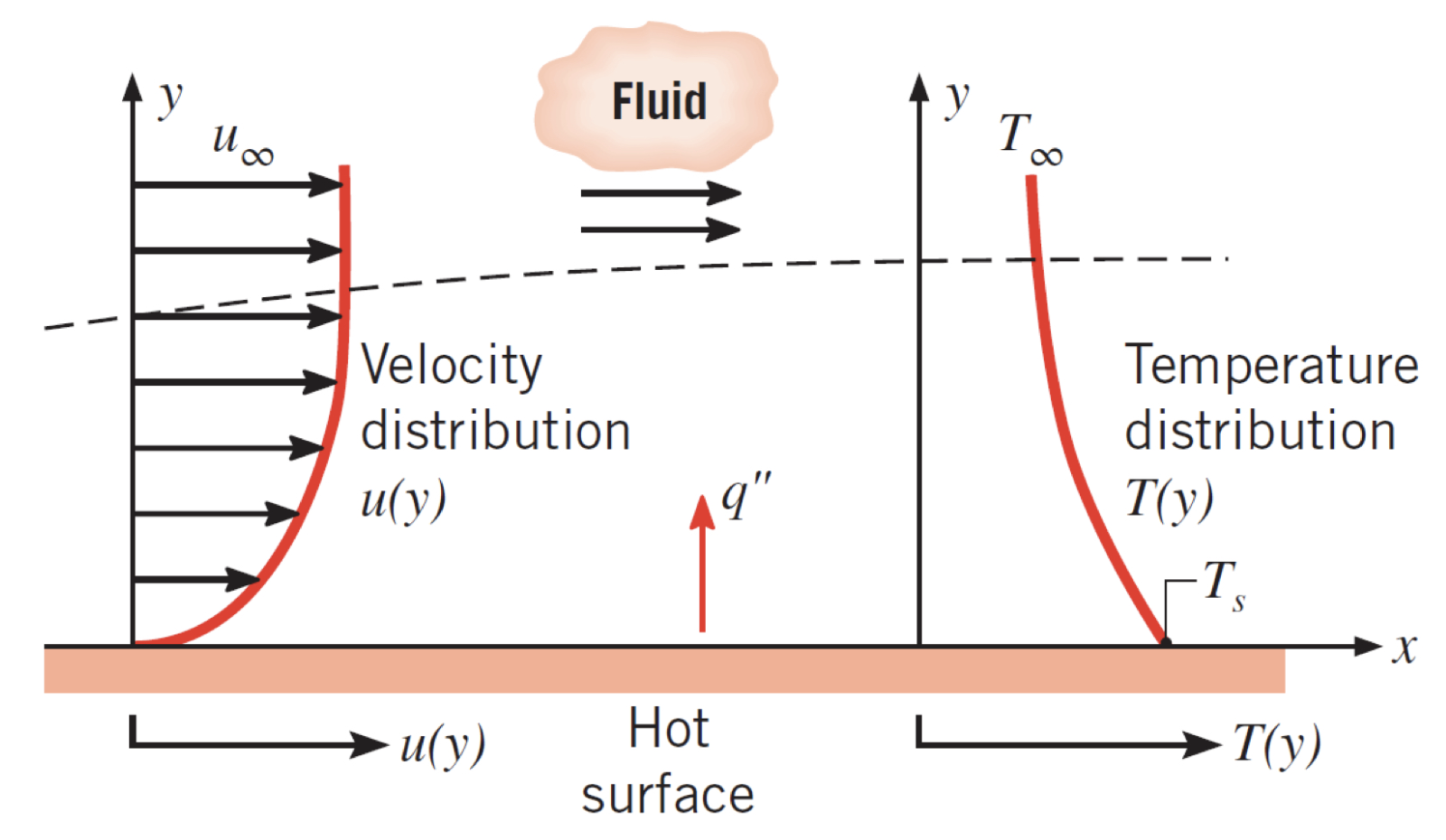
When a fluid flows over a surface, the fluid far from the surface moves at the free-stream velocity, whereas the fluid in close contact with the surface is stationary. This phenomenon is known as the no-slip condition, which states that fluid at a solid boundary has zero velocity relative to the solid surface. So the velocity boundary layer is the region near the surface where the fluid velocity transitions from zero at the solid surface (result of no-slip condition) to the free-stream velocity of the bulk fluid far from the surface.
Thermal Boundary Layer
Due to the no-slip condition, the fluid close to the surface is at rest. As a result, if the surface temperature differs from the fluid, then this stationary fluid layer will take on the surface temperature. Consequently, a temperature gradient will develop in the fluid near the wall, resulting in a thermal boundary layer.
The thermal boundary layer is therefore the region near the surface where fluid temperature changes from the surface temperature to that of the bulk fluid temperature. Within this boundary region, thermal gradients are large. Outside this boundary region, thermal gradients are small, meaning the fluid temperature will be relatively uniform.
Note that unlike the velocity boundary layer, the thermal boundary layer does not always exist. It is present only when there is a temperature difference between the surface and bulk fluid.
Dimensionless Flow Parameters
Table 1: Dimensionless flow parameters and their definitions. \( L \) is the characteristic length (or \( R \) in radial coordinates).
| Term | Definition | Physical significance |
|---|---|---|
| Reynolds | \( Re = \frac{\rho V L}{\mu} = \frac{V L}{\nu} \) | Ratio of inertial forces to viscous forces, determining if flow is laminar or turbulent |
| Biot | \( Bi = \frac{h L_{c}}{k} \) | Ratio of internal conduction resistance to external convection resistance, determining if heat transfer is limited internally or at its surface |
| Nusselt | \( Nu = \frac{h L}{k} \) | Ratio of convective heat transfer to conductive heat transfer in a fluid |
| Prandtl | \( Pr = \frac{\nu}{\alpha} = \frac{\mu c_{p}}{k} \) | Ratio of momentum diffusivity to thermal diffusivity |
| Grashof | \( Gr = \frac{g \beta (T_{s} - T_{\infty}) L^{3} }{\nu^2} \) | Ratio of buoyancy forces to viscous forces |
Types of Flow
Laminar flow is orderly and created from viscous fluids, stagnant rivers, airflow cabinets, etc. It can be identified by the Reynolds Number. Flow is determined to be laminar if \( Re < 2 x 10^{5} \).
Turbulent flow is chaotic and created from quick streams, fans/AC, pumps, etc. It is also identified by the Reynolds Number. Flow is determined to be turbulent if \( Re > 3 x 10^{6} \).
Transition region flow is is a region where the flow is in between laminar and turbulent characteristics and cannot be specifically identified as one or the other. Flow is determined to be in the transition region if \( 2x10^{5}< Re < 3 x 10^{6} \).

Application Alert!
During blood pressure measurements, the brachial artery is constricted. When the cuff is deflated below systolic pressure, flow becomes turbulent and Korotkoff sounds can be heard through the stethoscope. Below diastolic pressure, flow becomes laminar again and no sounds are heard.
In atherosclerosis, accumulation of plaque on narrowing artery walls limits the flow of blood. Sites of bifurcation (branching or curving of blood vessels) often exhibit turbulent flow dynamics; these regions are thus more susceptible to plaque build-up. Read more: A Turbulent Path to Plaque Formation (Nature, 2016).
Convective Heat Transfer Coefficient
To solve for the convective, heat transfer coefficient (\( h \)):
- Identify the solid's geometry: flat plate, cylinder, or sphere
- Find \( L \) (characteristic length)
- Identify natural or forced convection
- Identify laminar or turbulent flow using the Reynold's Number
- Choose the appropriate equation
To find the various Nusselt Number equations based on geometry and type of convection, visit Empirical Correlations for Convective Heat Transfer Coefficients.
Flat Plate, Forced Convection
The convective heat transfer coefficient, \( h \), varies with distance along the flow for both laminar and turbulent flow.
To calculate \( h_{x} \) at a specific location \( x \), use the local Nusselt number (\( Nu_{x} \)):
To calculate \( h_{L} \) over the entire object (\( L \)), use the average Nusselt number (\( Nu_{L} \)):
Flat Plate, Natural Convection
In conditions of natural convection, fluid moves due to changes in density compared to its surroundings (such as changes in temperature). With no forced convection, the Reynolds Number is not as useful. Instead, the Grashof Number can approximate the ratio of the buoyancy to viscous force on the fluid.
Cylinder, Forced Convection
- Flow over the cylinder: characteristic length = outside diameter \( D_{o} \) of cylinder
- Flow through the cylinder: characteristic length = inner diameter \( D_{i} \) of the tube
Cylinder, Natural Convection
- Vertical cylinder: characteristic length = height \( L \) of cylinder
- Horizontal cylinder: characteristic length = outside diameter \( D_{o} \) of cylinder
Sphere
The characteristic length for both forced and natural convection is the diameter \( D \) of the sphere.
Heads Up!
When considering convection over a surface, the characteristic length refers to how far the fluid must travel over/around the system. For example, fluid encountering a sphere would need to travel around its diameter.
This differs from the characteristic length described in conduction, which is the path that heat must take to escape from a solid object. In this instance, heat would escape most quickly through the radius of the sphere.