Modes of Heat & Mass Transfer
Transport phenomena describe how energy, mass, charge, and momentum move through systems, whether biological or engineered systems. These transport processes reduce gradients over time, moving the system toward equilibrium. An important principle to understand is that transport occurs when a driving force exists, which is proportional to flow. At the same time, a resistance to flow will impede its motion. The flow relationship is described in an Ohm's Law type of formulation. For example, the fluid flow through a blood vessel, \( q = \frac{ΔP}{R} \), is proportional to the pressure difference across the vessel divided by the resistance throughout the vessel.
These Reference Pages will focus primarily on heat transport (the transfer of thermal energy) and mass transfer (the movement of chemical species). On this page, primary mechanisms of their transport are introduced.
Heat Transfer
Heads Up!
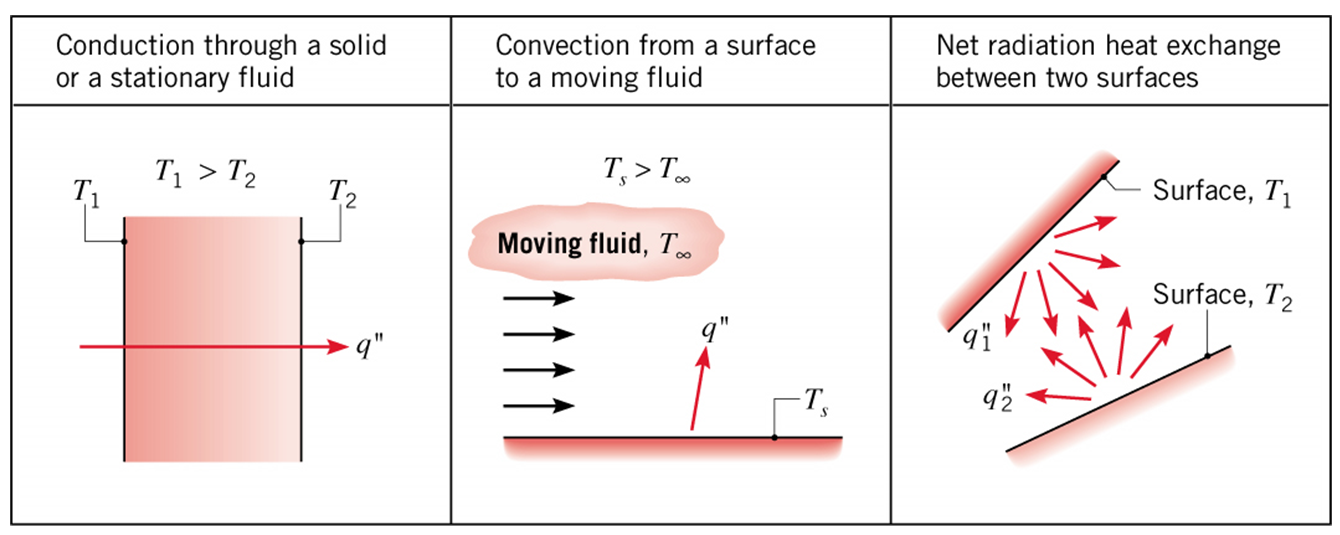
Read about these modes of heat transfer in more detail on the following pages: conduction, convective heat transfer, and radiation.
Conduction
Conduction occurs through direct molecular motion within a material, without any bulk motion of the material itself. When a temperature gradient exists within a solid, thermal energy is transferred from regions of high temperature to regions of lower temperature as molecules randomly collide. When two solids at different temperatures are placed in contact, thermal energy is transferred from the hotter material to the cooler object until thermal equilibrium is reached (i.e., the objects are at the same temperature).
Convective Heat Transfer
Convective head transfer occurs due to the bulk motion of a fluid. A fluid is any substance that can flow, including both liquids and gases such as air, water, or blood. As it flows with some velocity, it carries heat by virtue of its motion.
Radiation
Radiation occurs due to the emission and absorption of electromagnetic waves. It does not require direct contact or fluid motion. A familiar example of radiative heat transfer is feeling warmth from the sun. In biological systems, radiation contributes to bidirectional heat exchange between the system and its surroundings, as the body can continuously emit and absorb infrared radiation.
Summary of Heat Transfer Modes
Table 1: Summary of heat transfer modes.
| Mode | Description | Described by |
|---|---|---|
| Conduction | Spontaneous movement of thermal energy down a temperature gradient due to random molecular movement | Fourier's Law: \( q^{''}_x = \frac{q_x}{A} = -k \frac{dT}{dx} \) |
| Convection | Transport of thermal energy due to bulk motion of a fluid (a liquid or a gas) over a surface | Newtion's Law of Cooling: \( q_{1-2} = hA(T_1 - T_2) \) |
| Radiation | Transport of thermal energy emitted as electromagnetic waves | Stefan-Boltzmann Law: \( q^{''} = \frac{q}{A} = \sigma T^4 \) |
Mass Transfer
Heads Up!
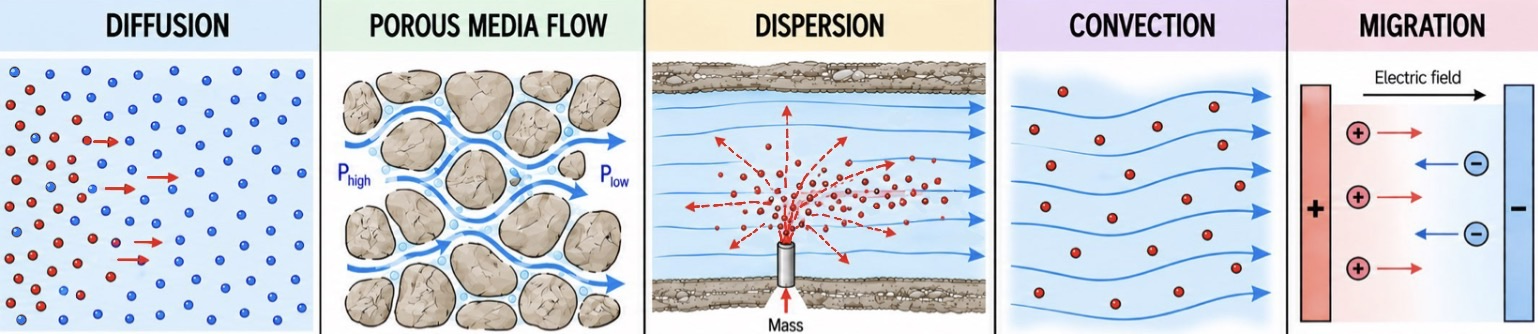
Read about these modes of mass transfer in more detail on the following pages: diffusion, porous media flow, and convective mass transfer.
Diffusion
Diffusion is a mode of mass transfer driven by the random motion of molecules. When a concentration gradient exists, molecules move randomly, but on average, there will be a net movement of species from regions of higher concentration to lower concentration. Diffusion doesn’t require bulk fluid motion.
Porous Media Flow
Porous media flow can be describes as the bulk movement of a fluid in a porous media due to hydraulic forces. Porous mediums can be approximated as a bundle of tubes of varying diameter, embedded within a solid matrix, and can be described by Darcy's Law. Three common types of porous media flow are capillary flow, unsaturated flow, and osmotic flow.
Dispersion
Dispersive mass transfer is desribed as a random mixing component in addition to molecular diffusion (which spreads a mass component/species from higher to lower concentrations). There are two types of dispersive mass transfer:
- Hydrodynamic (fluid systems): spreading of liquid or gas from path it would follow, due to the bulk flow or the convective hydraulics of the system.
- Mechanical (porous media): caused by differences in pore velocity distribution, individual pore sizes and paths, and tortuosity or branching.
If dispersion present, its effect is generally much higher than diffusion, because of flow (usually turbulent).
Convective Mass Transfer
Convective mass transfer refers to the movement of mass through a medium as a result of the net motion of a material in the medium. It is an added effect of bulk flow on top of diffusion or dispersion, and is studied the same way as convective heat transfer.
Summary of Mass Transfer Modes
Table 2: Summary of mass transfer modes.
| Mode | Description | Described by |
|---|---|---|
| Molecular diffusion | Spontaneous movement of mass (solid, liquid, gas) down a concentration gradient due to random molecular movement | Fick's Law: \( j_{A,x} = -D_{AB}\frac{dc_{A}}{dx} \) |
| Capillary diffusion | Movement of mass due to capillary action in a porous medium | (mathematically similar to molecular diffusion) |
| Bulk flow through porous media | Bulk movement of a fluid in a porous media due to hydraulic forces (pressure, matric forces, gravity) | Darcy's Law: \( n^{v} = -K\frac{\partial \mathcal{H}}{\partial s} \) |
| Dispersion | Spreading of fluid from its bulk flow path (similar effects to molecular diffusion, but different mechanisms; due to turbulence in fluid) | \( j_{A,x} = -E_{x}\frac{dc_{A}}{dx} \) |
| Convection | Addition of bulk flow to diffusion or dispersion | \( N_{A_{1-2}} = h_{m}A(c_{1}-c_{2}) \) |