Zeroth Law: Thermal Equilibrium
The zeroth law of thermodynamics establishes the concept of thermal equilibrium and provides a foundation for defining and measuring temperature. It states that if two systems are in thermal equilibrium with a third, then they are in thermal equilibrium with each other. If a temperature difference exists, then heat will flow (from hot to cold) only until thermal equilibrium is reached. Therefore, the zeroth law essentially defines the condition under which we expect heat transfer to cease.
This law plays a crucial role in understanding heat transfer by identifying that temperature is a shared property of systems in equilibrium and explaining why it can be compared consistently between different objects. It also provides the physical justification for the use of thermometers. When they are placed in contact with an object and allowed to reach thermal equilibrium, the thermometer and the object share the same temperature.
Remember!
Temperature and heat are related, but not the same thing! Temperature is a property of an object or system that describes the average kinetic energy of the particles within it. Heat refers specifically to the transfer of thermal energy across a system boundary due to a temperature difference.
First Law: Conservation of Energy
The first law of thermodynamics expresses the principle of energy conservation: energy cannot be created or destroyed, and can only be transferred or converted between forms. This law helps in understanding all situations of heat transfer and explains why temperature change occurs.
A system’s temperature can increase only if thermal energy enters the system or is generated internally, and it can only decrease if thermal energy leaves the system or is consumed. Temperature changes as a consequence of energy transfer or conversion, and never spontaneously.
When the first law is applied to heat transfer problems, it is expressed as a balance within the boundary of the system: energy entering the system, energy leaving the system, generation or consumption of heat within the system, and energy stored within the system.
Need a review?
Check out Heat and Work in Conservation of Energy for more details.
Second Law: Directionality of Heat Transfer
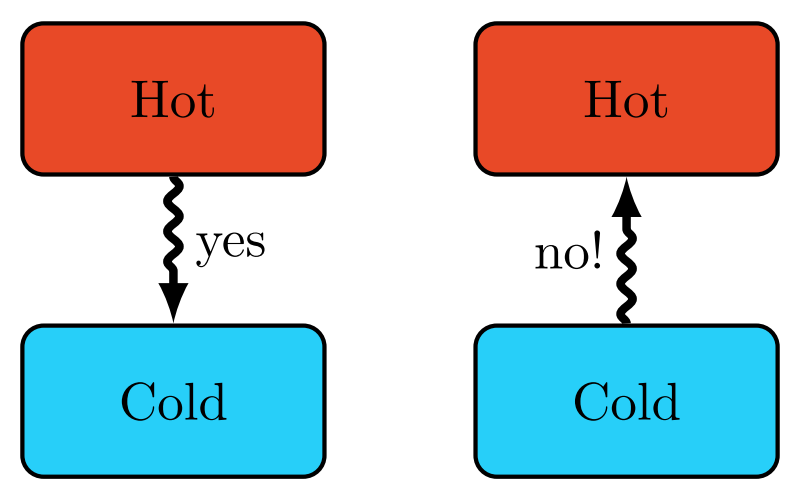
The second law of thermodynamics is important in understanding the directionality of heat transfer. It states that in an isolated system, the total energy of the system can only increase or remain constant over time.
In heat transfer, this explains why heat transfer only spontaneously occurs from regions of higher temperature to regions of lower temperature. This type of transfer increases the total entropy of the system in alignment with the second law.