What is Transport?
Transport refers to how energy, mass, charge, and momentum move through systems, and it is a core concept in biology, the environment, and engineering. These processes are essential for the function of living systems, operate across wide scales, and are critical to the design and function of bioengineered technologies.
To fully understand transport within the scope of bioengineering, biological context and mathematical tools are combined to analyze living systems such as plants, animals, and the human body, as well as natural systems like air, water, and soil. Unlike purely mechanical or chemical systems, biological systems involve additional complexities that affect transport, including metabolism, heat production, and oxygen consumption.
Similarities Between Heat & Mass Transfer
Heat and mass transfer are mathematically and conceptually analogous transport processes governed by gradients, material properties, conservation laws, and shared modes of diffusion and convection.
Both transport processes describe the movement of an extensive quantity driven by gradients and are governed by conservation laws (e.g., conservation of energy and conservation of mass). Gradients drive transport of heat and mass, generating flux. This flux is resisted by the heat conductance of the medium, or by the molecular diffusivity of the chemical species. For example, Ohm's Law governs the flow of electrons (ie. current), driven by voltage and hindered by resistance.
| Type of Flow | Heat | Mass | Electrical |
|---|---|---|---|
| What is Moving | Thermal energy (heat) | Chemical species | Charge (ions) |
| Driving Force | Temperature gradient | Concentration gradient | Electrical potential |
| Resistive Element | Thermal conductivity (k) | Molecular diffusivity (D) | Electrical resistance (R) |
| Governed By | Fourier's Law | Fick's Law | Ohm's Law |
Table 1: A comparison of components in various types of flow.
Need a review?
These concepts have also been covered in Conservation of Mass and Conservation of Energy.
Energy Balance
By the First Law of Thermodynamics, total energy of a system must be conserved. (Though the sum is constant, it can be converted between forms such as kinetic, potential, thermal, etc.)
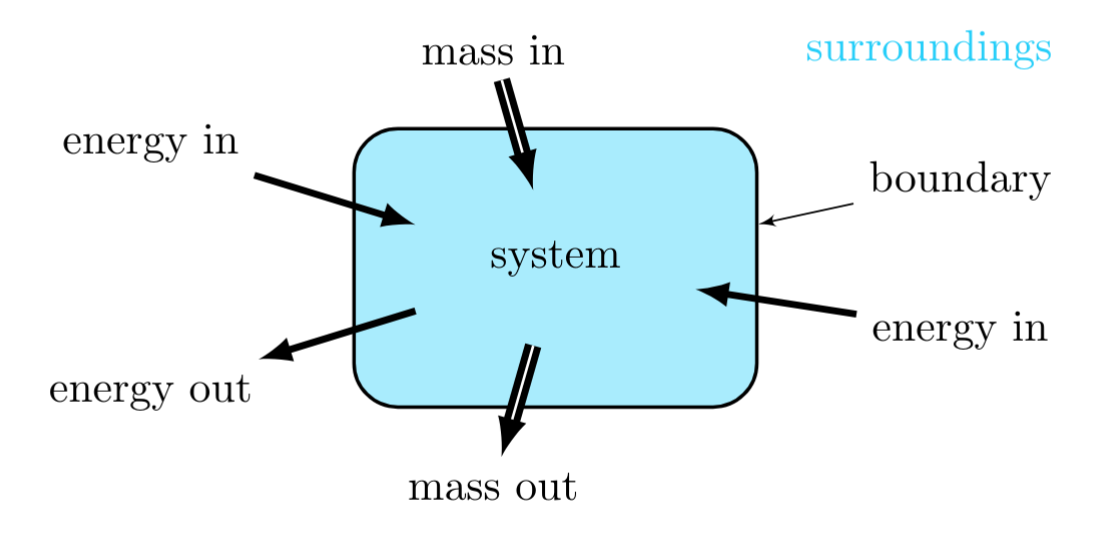
When this is applied to heat transport, for example, it is expressed as a balance within the boundaries of the system: thermal energy entering or leaving the system by diffusion and/or convection (together, a net energy transfer across the system boundary), generation (positive) or consumption (negative) of heat within the system, and thermal energy stored within the system. These are expressed as rates:
Heads Up!
Generation of heat and storage of heat are not the same thing!
Generation is the transformation of energy from other forms into heat (i.e., the cause) whereas storage of heat is manifested by a change in temperature (i.e, the effect).