Time Domain
Introduction
The most intuitive way for signals to be represented is in the time domain. Any particular signal is made up of a measured value on the y axis, and the time at which that measurement was obtained on the x axis. These signals are directly related to physical signals, for example, the electrical impulses that control heart rate in an EKG is measured in the time domain and provides useful physiological information about the patient it is sourced from.
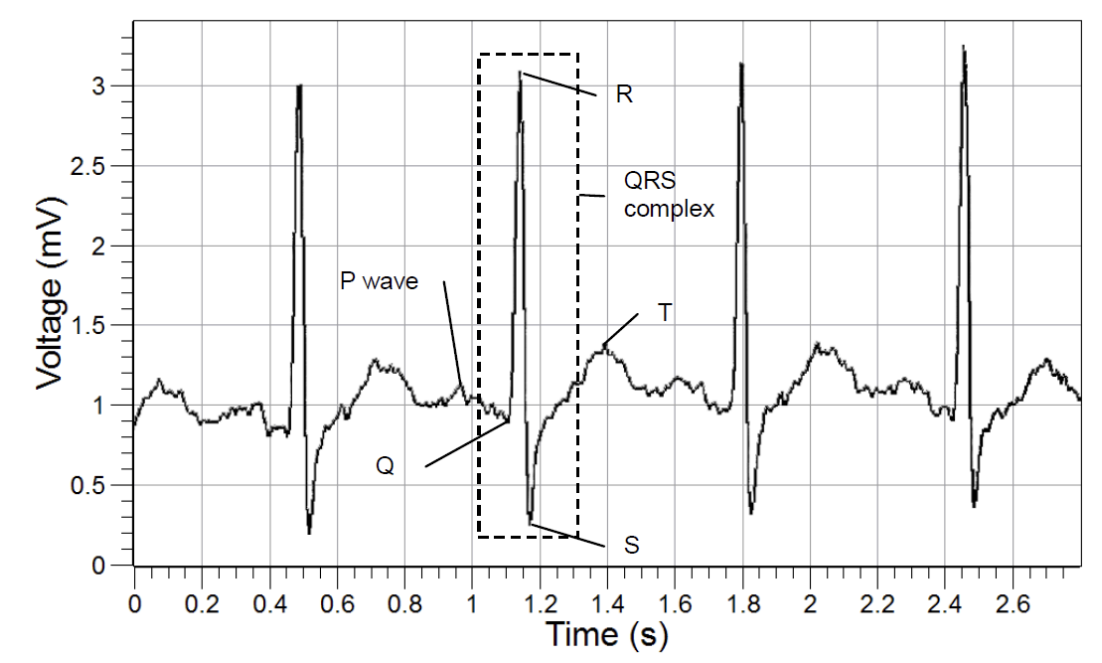
In this EKG, the time domain is useful for analysing the PQRST components of the heart's electrical signals. Changes in the interval between these components such as delays, hastening, additional, or missing components can indicate pathology, and suggest specific causes.
Additional Info:
Learn more about how EKGs are used in healthcare from the American Heart Association.
Signal Characteristics
Signals within the time domain have a set of characteristics that can categorize the type of signal it is, what information it holds or lacks, and what can be done with it mathematically for analysis.
| Definition | Rough Picture |
|---|---|
| Sinusoid: Usually represents sounds. Defined mathematically with sine and cosine functions. | 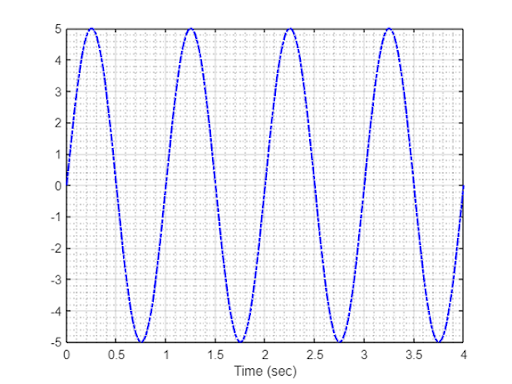 |
| Step: Represents different, digital states which the signal value jumps to instantaneously. A unit step jumps from 0 to 1. | 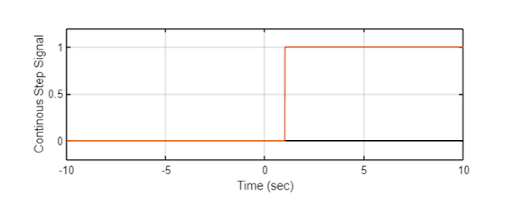 |
| Ramp/Triangle: A sweep function that either increases or decreases at a constant rate. Forms a ramp when changing values and triangle when returning to the original. | 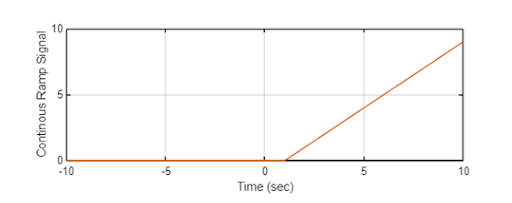 |
| Rectangle: A temporary state change that returns to the original value. Can be represented as two, opposite Step functions offset in time. | 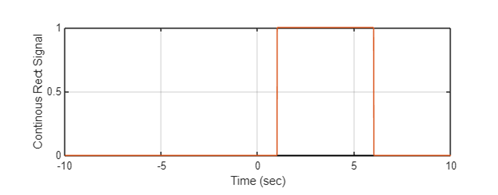 |
| Sinc: A decaying function that can be used to represent an attenuating signal, based on a sinusoidal signal. | 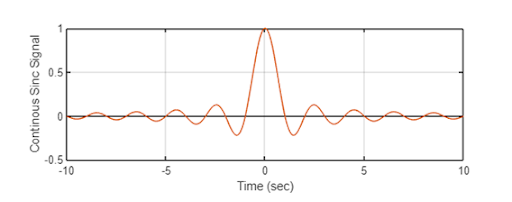 |
| Impulse: An infinitely tall and infinitely thin function. Useful for system response testing. | 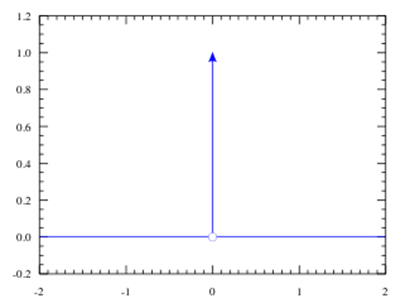 |
| Exponential: Can be used to represent non-linear functions, and things that have a limit or asymptote. | 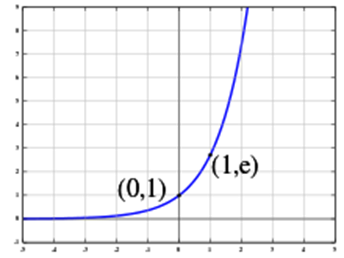 |
These definitions describe the shape of various signals. Step and Impulse signals are especially useful as inputs in system design. Since these signals are expected to produce a specific, known response, the response that they produce can be used to characterize the system they were passed through.
Likewise, sinusoids are incredibly common outputs from systems. They are present anytime oscillations occur in a signal from noise, or repeated signals such as the EKG above. In addition, they are used in Fourier analysis by approximating a complicated waveform with stacked sine waves.
| Characteristic | Definition |
|---|---|
| Continuous vs Discrete | If the x axis (time) is smooth, or granular with occasionally sampled data. |
| Analog vs Digital | If the y axis is smooth, or granular with specific allowed values. |
| Deterministic vs Stochastic | If the signal is definable with an equation, or completely random. |
| Periodic vs Aperiodic | If the signal has a period T which is repeated, or if it is transient and non-repeating. |
| Time Invariant vs Nonstationary | If a delay or offset affects the signal then it is nonstationary. If not, it is time invariant. |
| Causal vs Noncausal | Where the signal of interest starts. If the signal starts before t = 0 then it is noncausal. |
| Linear vs Non-linear | Whether changes in system or input parameters affect the signal following homogeneity rules or not. |
Once we know the waveform and characteristics of a particular signal, we can start to predict its behavior and apply transformations to better understand the signal and its components.