Stability
What Is Stability?
When we have a system, there are three outcomes: stable, unstable, and marginally stable. Stable means that the system reaches a steady state, whereas unstable describes a system that explodes to infinity. Marginally stable is a distinct case where the system does not reach a steady state but remains bounded, such as a sinusoid.
Determining System Stability From Graphs
Using the Laplace transfer function, we can plot the poles and zeros on the complex s-plane, where the x-axis represents the real values and the y-axis represents imaginary values. For example, consider the equation:
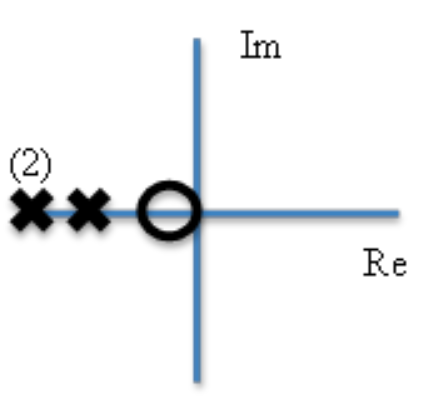
We solve for the s values. For the numerator, s = -0.5, which corresponds to a zero. For the denominator, s = -3 (double), -2, which correspond to poles. The plot below shows how we should plot this.
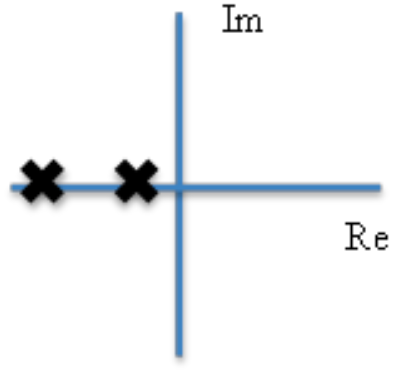
If all of the poles are in the left half-plane (LHP), the system is stable. This means that each pole has a negative real part and may or may not have an imaginary component as shown in the graph below. If a pole is purely real, the system response is a decaying exponential. If a pole is a complex number with a negative real part, the system exhibits oscillatory decay. Both are stable.
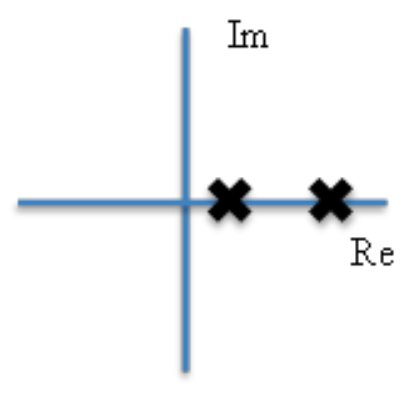
If any of the poles are in the right half-plane (RHP), the system is unstable. This means that at least one pole has a positive real part and may or may not have an imaginary component as shown in the graph below:
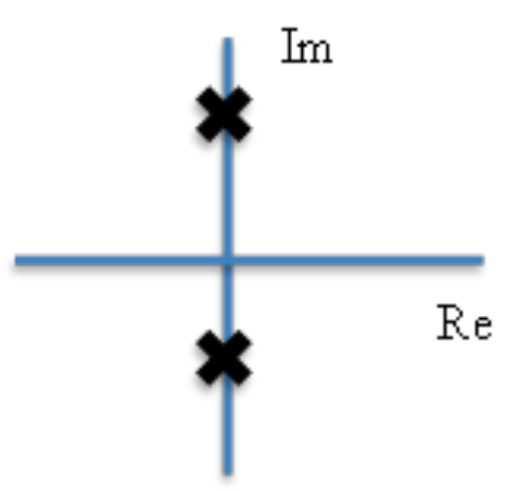
If any of the poles lie on the imaginary axis (with a real value of 0) and are not repeated, the system is marginally stable, as shown in the graph below:
Interactive Stability Simulator
Experiment with the interactive MATLAB-style simulator below. Drag the pole ✕ across the complex plane, adjust the sliders, or select presets to observe how the real component \( \sigma \) and imaginary component \( \omega \) directly dictate the stability and time-domain response \( y(t) \).
Interactive System Stability Lab
Drag the pole ✕ on the complex s-plane or use the sliders to watch how pole locations control real-time stability and impulse response.
The pole has a negative real part (σ < 0), causing exponential decay (eσt → 0). Nonzero imaginary components (ω ≠ 0) create oscillations. The system reaches steady state and is Stable.