Diffusion
Molecular diffusion is the transport of one mass component from a region of higher concentration to a region of lower concentration, making it a passive process.
It equilibrates differences in concentration, due to random (Brownian) molecular movement. As temperature increases, molecular kinetic energy also increases, speeding up the process.
It is analogous to diffusive heat transfer (thermal conduction), but can be more complicated if numerous chemical species are involved.
Learn More!
Diffusion and Osmosis are both passive transport where mass flows down the concentration gradient. Active transport involves the movement of mass against the concentration gradient.
Check out this interactive demonstration of diffusion, osmosis, and active transport.
Fick's Law
When concentration gradient is the driving force, the rate of mass transport per unit area (diffusive flux) is related to it via Fick's Law:
- \( j_{A,x} \) = diffusive flux of A, in x-direction \( \left [ \frac{kg}{m^{2} s}, \frac{kmol}{m^{2} s} \right] \)
- \( D_{AB} \) = mass diffusivity of A in B (diffusion coefficient) \( \left[\frac{m^{2}}{s}\right] \)
- \( c_A \) = concentration of A \( \left[\frac{kg}{m^{3}}, \frac{kmol}{m^{3}}\right] \)
- \( x \) = distance \( [m] \)
Consider a 1D diffusion process along the \( x \) direction. At any time, molecules have moved varying distances from the origin independently, with equal probability of moving left or right. Mean-square displacement \( \langle x^2 \rangle \) is the average of the square of displacements, and serves as a measure of how much molecules have spread.
Diffusivity is defined as one half of the mean-square displacement per unit time in 1D:
- \( D \) = diffusivity \( \left[\frac{m^{2}}{s}\right] \)
- \( \langle x^{2} \rangle \) = mean-square displacement \( [m^{2}] \)
- \( t \) = time \( [s] \)
The average diffusion velocity is then:
where
- \( u_{diff} \) = average diffusion velocity \( \left[\frac{m}{s}\right] \)
Heads Up!
Dispersive mass flux is written analogously to Fick's Law:
where
- \( j_{A,x} \) = dispersive flux of A at x \( \left[\frac{kg}{m^{2}s}\right] \) or \( \left[\frac{kmol}{m^{2}s}\right] \) (mass or molar flux)
- \( E_{x} \) = dispersion coefficient \( \left[\frac{m^{2}}{s}\right] \)
- \( c_{A} \) = concentration of A \( \left[\frac{kg}{m^{3}}\right] \) or \( \left[\frac{kmol}{m^{3}}\right] \)
- \( x \) = distance \( [m] \)
The dispersion coefficient \( E_{x} \) is a strong function of position \( x \). It is measured experimentally and is not a function of chemistry. It accounts for both dispersion and diffusion, and is therefore higher than mass diffusivity (\( D_{AB} \)).
Steady State
In steady state diffusion, concentration of mass does not change over time. However, concentration can change with position, and this gradient drives the transfer of mass. We can consider a few different situations of steady-state diffusion: in a slab, in a composite slab, and in the presence of a chemical reaction.
Steady State Diffusion in a Slab
Concentration Profile:
where
- \( c_{A}(x) \) = concentration profile \( [\frac{kg}{m^2}] \)
- \( x \) = position \( [m] \)
- \( c_{A1} \) = concentration at position \( x = 0 \)\( [\frac{kg}{m^2}] \)
- \( c_{A2} \) = concentration at position \( x = L \)\( [\frac{kg}{m^2}] \)
- \( L \) = length of slab \( [m] \)
Steady State Diffusion in a Composite Slab
With a composite slab, convection occurs on either side of the slab while diffusion occurs within the slab. This means mass transfer is occuring between two phases at the surface. The concentrations at the interface are not equal. For example, the surface concentration is different in liquid vs in the solid.
Mass flow can be calculated by concentration differences and mass transfer resistances:
where
- \( N_{A,x} \) = mass flow \( [\frac{m}{s}] \)
- \( \triangle c \) = change in concentration \( [\frac{kg}{m^2}] \)
- \( \triangle L \) = length of slab \( [m] \)
- \( h_{m1} \) = mass transfer coefficient of side 1 \( [\frac{m}{s}] \)
- \( h_{m2} \) = mass transfer coefficient of side 2 \( [\frac{m}{s}] \)
- \( A \) = cross sectional area of slab \( [m^2] \)
- \( D_{AB} \) = diffusivity of slab \( [\frac{m^2}{s}] \)
- \( K^* \) = distribution coefficient
| Geometry | Temperature Profile | Mass Flow | Diffusive Resistance |
|---|---|---|---|
| Slab | \( c(x) = c_1 + \frac{c_2 - c_1}{L} x \) | \( N_{A,x} = \frac{c_1 - c_2}{\frac{L}{D_{AB}A}} \) | \( \frac{L}{D_{AB}A} \) |
| Hollow Cylinder | \( c(r) = c_{i}-\frac{c_{i}-c_{0}}{ln(r_{0}/r_{i}}ln(\frac{r}{r_{i}}) \) | \( N_{A,r} = \frac{c_{i}-c_{0}}{\frac{ln(r_{0}/r_{i})}{2 \pi D_{AB} L}} \) | \( \frac{ln(r_{0}/r_{i})}{2 \pi D_{AB} L} \) |
| Hollow Sphere | \( c(r) = c_{i}-(c_{i}-c_{0}) \frac{r-r_{i}}{r_{0}-r_{i}} \frac{r_{0}}{r} \) | \( N_{A,r} = \frac{T_{i}-T_{0}}{(r_{0}-r_{i})(4 \pi r_{0} r_{i} D_{AB})} \) | \( \frac{r_{0}-r_{i}}{4 \pi r_{0} r_{i} D_{AB}} \) |
Table 1: Steady-state concentration, flow, and diffusive resistance in slab (Cartesian), cylindrical, and spherical geometries.
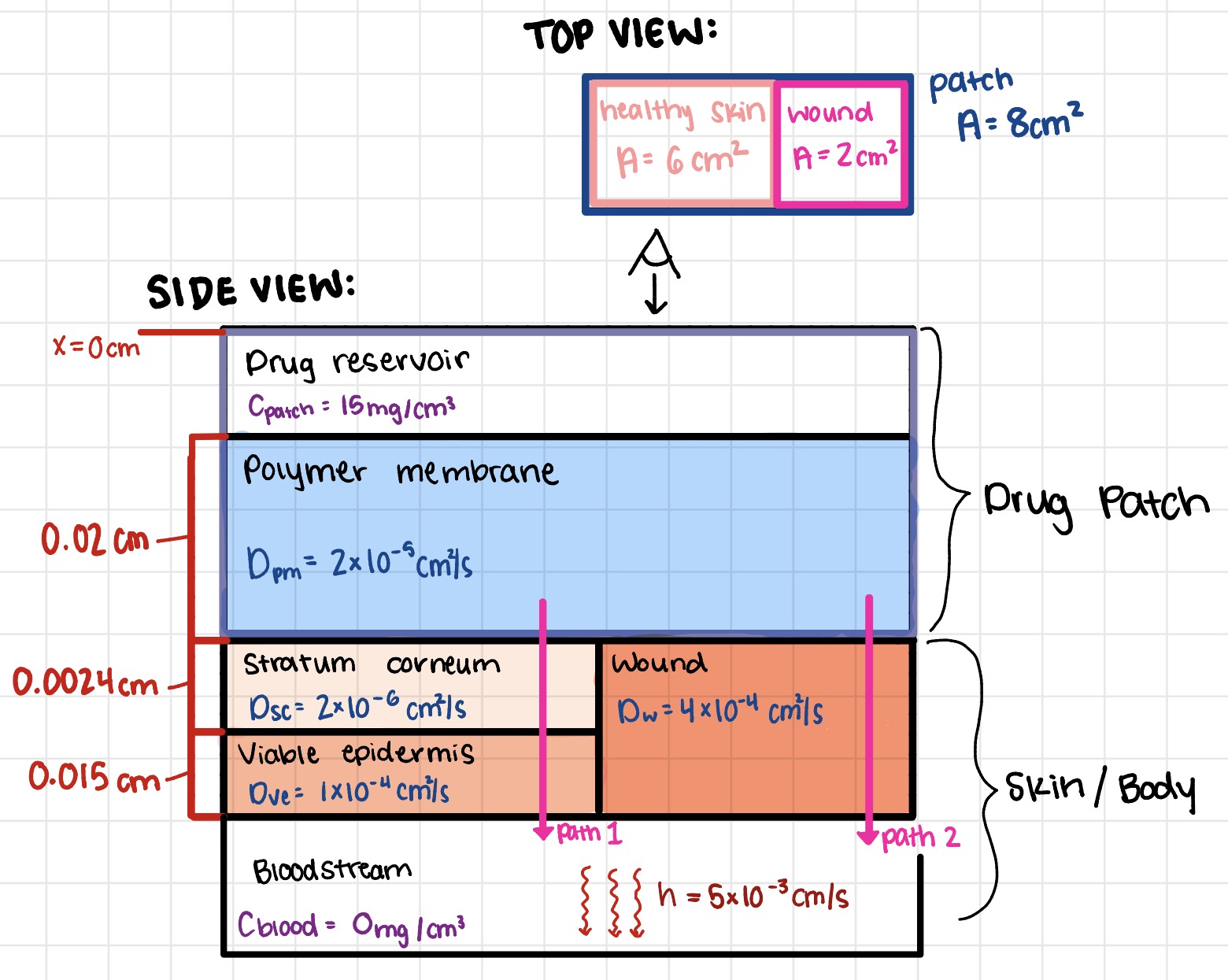
A medicated patch delivers drugs into underlying tissue. The patch covers both healthy skin and a small wound, creating two parallel diffusion pathways.
First, the drug diffuses through the polymer membrane of the patch.
Then, it travels through either:
- Path 1 (Healthy Skin): polymer \( \rightarrow \) stratum corneum (sc) \( \rightarrow \) viable epidermis (ve)
- Path 2 (Wound): polymer \( \rightarrow \) wound
Finally, the drug enters the bloodstream by convection beneath the tissue.
Assume:
- Diffusivities are different within each layer.
- The initial concentration of drug in the patch vs bloodstream is different.
- No partition coefficient between patch and skin.
Refer to the image below to find the diffusivity and thickness of each layer, cross sectional areas, convective coefficient for the convection layer, and the initial and final concentrations.
(A) Identify the boundary/initial conditions.
(B) Draw the analogous circuit diagram.
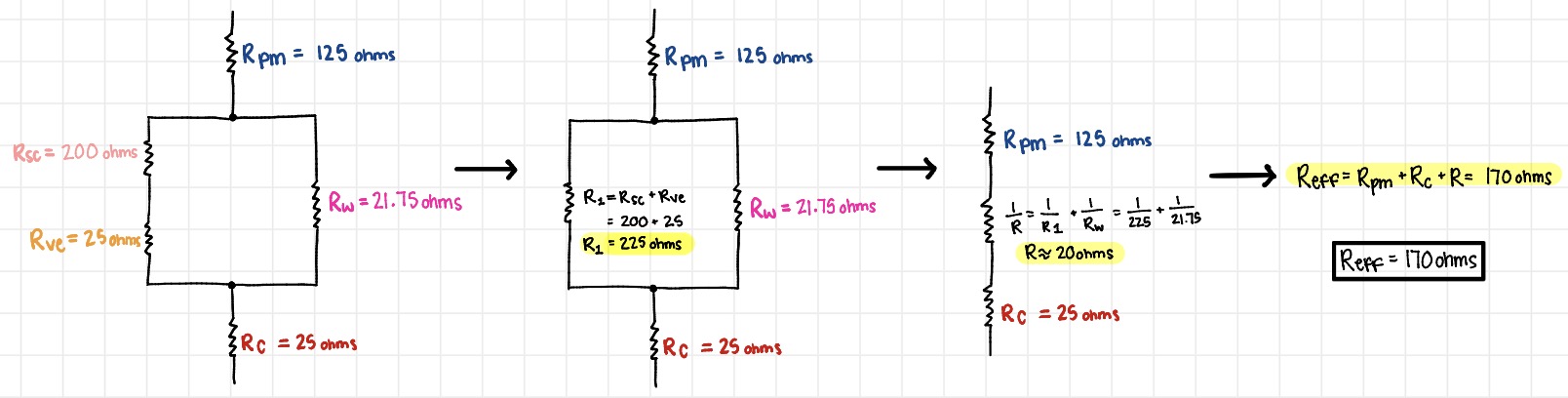
(C) Calculate each resistance and find the equivalent resistance.
(D) Calculate the overall drug transfer rate.
(E) Find the conductance of Path 1 vs Path 2.
Hint: Conductance is the inverse of resistance. For this problem, conductance is a measure of how easily the drug can diffuse through each pathway.
(F) Calculate the drug percentage through the healthy skin vs wound.
Hint: The fraction of drug traveling through a path is proportional to the fraction of the path's conductance over the total conductance.
(G) Does it make sense that the drug is flowing stronger through one path than the other?
(A) Identify the boundary/initial conditions.
- \( C_{patch}(t=0) = 15 \frac{mg}{cm^3} \) - Initial concentration of drug in the patch
- \( C_{blood}(t=0) = 0 \frac{mg}{cm^3} \) - Initial concentration of drug in the bloodstream
- \( \frac{\delta C}{\delta x}|_{x=0} = 0 \frac{mg}{cm^{2}s} \) - No drug intake from the atmosphere
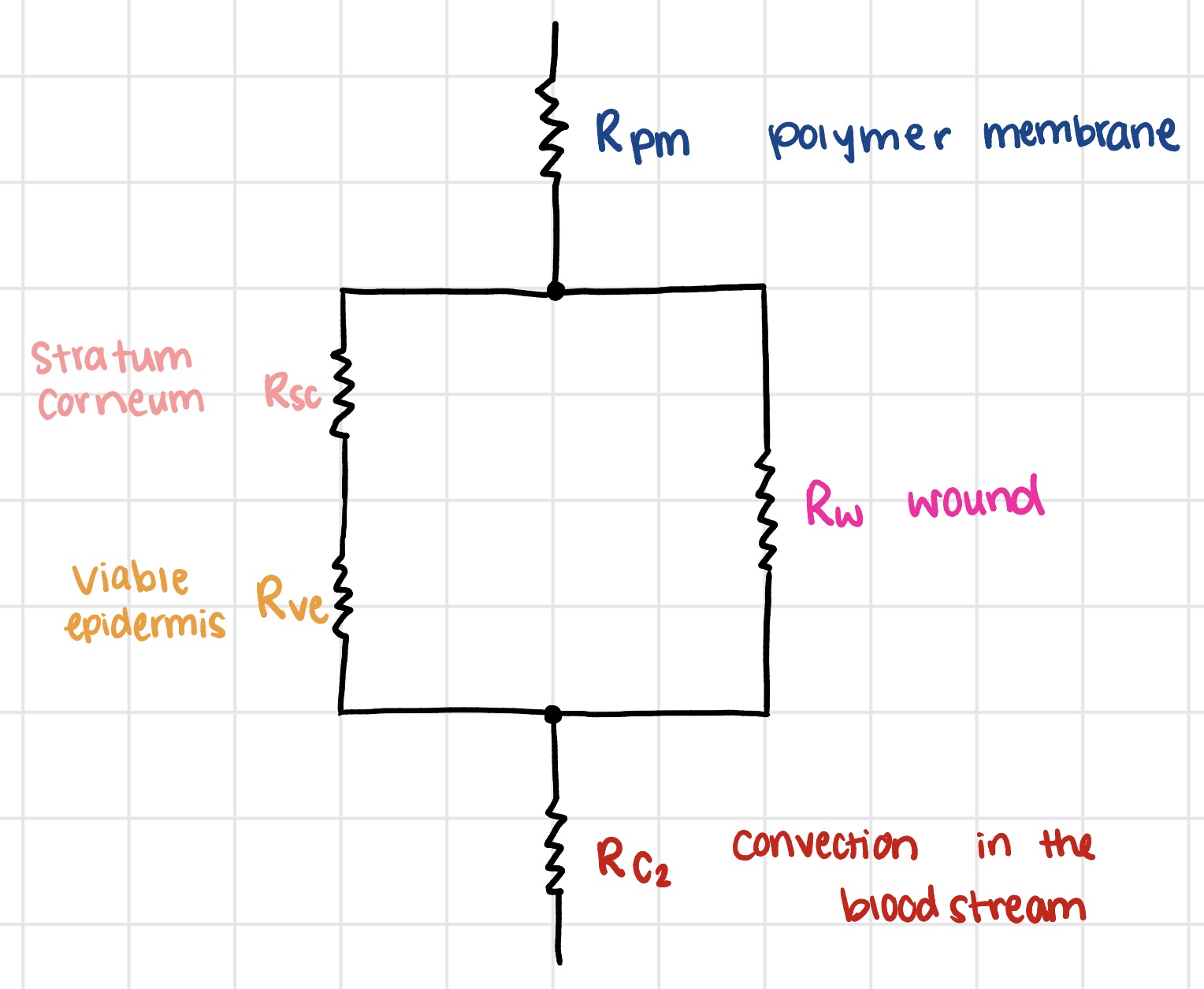
(B) Draw the analogous circuit diagram.
(C) Resistances and Equivalent Resistance
Calculating resistances:
Diffusion resistances: \( R = \frac{L}{DA} \)
\( R_{pm} = \frac{0.02}{(0.00002)(8)} = 125 \frac{s}{m^3} \)
\( R_{sc} = \frac{0.0024}{(0.000002)(6)} = 200 \frac{s}{m^3} \)
\( R_{ve} = \frac{0.015}{(0.0001)(6)} = 25 \frac{s}{m^3} \)
\( R_{w} = \frac{0.017}{(0.0004)(2)} = 21.75 \frac{s}{m^3} \)
Convection resistance: \( R = \frac{1}{hA} \)
\( R_{c} = \frac{1}{(0.005)(8)} = 25 \frac{s}{m^3} \)
Calculating effective resistance:
(D) Drug Transfer Rate:
\( N = \frac{\triangle C}{R_{eff}} = \frac{15-0}{170} = 0.088 \frac{mg}{s} \)
(E) Find the conductance of Path 1 vs Path 2.
Path 1 (Healthy) Conductance:
\( G_{1} = \frac{1}{R_{sc} + R_{ve}} = \frac{1}{200 + 25} = \frac{1}{225} = 0.0044 S \)
Path 2 (Wound) Conductance:
\( G_{2} =\frac{1}{R_{w}} = \frac{1}{21.75} = 0.046 S \)
(F) Calculate the drug percentage through the healthy skin vs wound.
Total Conductance:
\( G_{total} = G_{1} + G_{2} = 0.0044 + 0.046 = 0.0504 \)
Healthy Skin Percentage:
\( \frac{G_1}{G_{total}} = \frac{0.0044}{0.0504} = 0.09 = 9 \% \)
Wounded Skin Percentage:
\( \frac{G_2}{G_{total}} = \frac{0.046}{0.0504} = 0.91 = 91 \% \)
(G) Does it make sense that the drug is flowing stronger through one pathway than the other?
Yes, it makes sense that the drug flows stronger through Path 2 (wounded skin), because Path 1 had a much higher resistance than Path 2.
Need a Review?
You can find a review of resistance in series and parallel and an example of how it shows up in biological systems on the Conduction page.
Steady State Diffusion in a Slab with a Chemical Reaction
Chemical reactions can occur during diffusion. This produces a decay with time. Consequently, the surface flux increases while the concentration gradient gets higher.
Concentration Profile:
For thick material (semi-infinite), the limit as L approaches \( \infty \) is taken:
where
- \( m = \sqrt{\frac{k^{''}}{D_{AB}}} \)
- \( x \) = position \( [m] \)
- \( c_{A} \) = concentration \( [\frac{kg}{m^2}] \)
- \( c_{A,0} \) = initial concentration \( [\frac{kg}{m^2}] \)
- \( L \) = length of slab \( [m] \)
Unsteady State
In unsteady state diffusion, also called transient diffusion, concentration changes over time. There are three situations of unsteady state diffusion that will be examined here. First, characteristic length and the mass transfer Biot number will need to be defined.
Biot Number
The mass transfer Biot number (\( Bi_m \)) is used to determine if the internal resistance within an object is negligible. If it is negligible, this means there is very little concentration variation within the solid. It is calculated as a fraction of internal and external resistance:
where
- \( h_m \) = convective mass transfer coefficient \( [\frac{m}{s}] \)
- \( L \) = characteristic length \( [m] \)
- \( D_{AB} \) = diffusivity \( [\frac{m^{2}}{s}] \)
- \( K^* \) = partition coefficient for mass transfer between the internal solid phase and the external fluid phase
If \( Bi_m < 0.1 \), the internal resistance can be ignored, and no spatial variation in concentration can be assumed. In other words, concentration changes only as a function of time. If \( Bi_m > 0.1 \), the internal resistance cannot be ignored due to spatial variation in concentration within the solid.
Need a Review?
Review Characteristic Length on the Conduction page!
No Spatial Variation in Concentration
If concentration does not change with position and only changes with time, a lumped parameter approximation can be used. When internal resistance is very low compared to the external resistance, the total resistance can be assumed to be external resistance and the concentration will not vary inside the object.
To determine if there is no spatial variation in concentration, use the mass transfer Biot Number!
- If \( Bi_m < 0.1 \), the lumped parameter approximation can be used
For mass transfer, the lumped parameter approach is commonly used to describe drying. For example, moisture can evaporate from the surface of a wet solid and be removed by air flowing over it. If water diffuses quickly inside the solid, the moisture concentration inside the solid can be treated as spatially uniform.
A mass balance on the water content in the solid gives:
where
- \( w \) = moisture content of the solid
- \( m_s \) = dry mass of the solid \( [kg] \)
- \( A \) = surface area of the solid \( [m^{2}] \)
- \( c_s \) = water vapor concentration next to the solid surface \( [\frac{kg}{m^{3}}] \)
- \( c_{\infty} \) = water vapor concentration in the bulk air \( [\frac{kg}{m^{3}}] \)
- \( h_m \) = convective mass transfer coefficient \( [\frac{m}{s}] \)
When the solid surface has free water, the surface concentration is constant. In this case, moisture changes linearly with time:
When the solid surface does not have free water, the surface concentration is no longer constant. In this case, the drying rate decreases over time, and the moisture content follows an exponential decay.
Spatial Variation in Concentration
If the internal resistance is significant, concentration variation inside cannot be ignored. There are multiple cases for unsteady diffusion when concentration changes with both position and time. For a simple slab geometry where concentration changes with position, a series solution can be used.
Use the mass transfer Biot Number to determine if internal resistance is significant!
- If \( Bi_m > 0.1 \), internal resistance is significant
For a slab with concentration varying along its thickness, the governing equation is:
This applies when there is no bulk flow and no chemical reaction.
Series Solution:
You can solve the series solution two different ways: using more than one term of the series solution or using a Heisler Chart.
Heisler Charts are used to describe the relationship between the concentration, position, and time variables. They plot the 1st term of the series solution and are used for the long-time approximation.
The Fourier Number is used to determine long times:
where
- \( D_{AB} \) = diffusivity \( [\frac{m^{2}}{s}] \)
- \( t \) = time \( [s] \)
- \( L \) = characteristic length \( [m] \)
In order to use the Heisler Chart your system must satisfy the following:
- Uniform initial concentration, \( c_i \)
- Constant boundary fluid concentration
- Perfect slab, cylinder, or sphere geometry
- Far from edges
- No chemical reaction \( (r_A=0) \)
- Constant diffusivity \( (D_{AB}) \)
- Long time approximation: \( F_{o} > 0.2 \)
If \( F_o < 0.2 \), more than one term of the series solution may be needed.
Learn More!
To learn how to use the Heisler Chart, visit the Reference Library & Resources Page!
Near the Surface of a Large Body
The second method to analyze systems with spatial and time variation of concentration \( (Bi_m > 0.1) \) is for short time and/or thick material. This can be solved with the semi-infinite region solution.
A semi-infinite region is an idealized geometry that extends to infinity in two directions and has a single identifiable surface in the other direction. This approximation is useful for practical situations of mass transfer in thin materials over shorter time or thick materials over longer time.
The material can be approximated as semi-infinite when:
where
- \( L \) = characteristic length \( [m] \)
- \( t \) = time \( [s] \)
- \( D_{AB} \) = diffusivity \( [\frac{m^{2}}{s}] \)
Semi-infinite Region Solution:
where
- \( c \) = concentration at x \( [\frac{kg}{m^{3}}] \)
- \( c_i \) = initial concentration at \( t=0 \) and far from the surface \( [\frac{kg}{m^{3}}] \)
- \( c_s \) = surface concentration \( [\frac{kg}{m^{3}}] \)
- \( x \) = specified location \( [m] \)
- \( D_{AB} \) = diffusivity \( [\frac{m^{2}}{s}] \)
- \( t \) = time \( [s] \)
For Reference!
A chart with the error function (erf) is provided on the formula sheet found on the Reference Library & Resources Page!
Solutions Summary Table
| Situation | Biot Number | Thickness / Time Condition | Solution Equation |
|---|---|---|---|
| Lumped | \( Bi_m < 0.1 \) | N/A | \( w-w_i = -\frac{h_mA}{m_s}(c_s-c_{\infty})t \) |
| Series | \( Bi_m > 0.1 \) | Finite geometry; \( F_o > 0.2 \) for Heisler Chart | \( \frac{c-c_s}{c_i-c_s} =\sum_{n=0}^{\infty} \frac{4(-1)^n}{(2n+1)\pi} \cos\left(\frac{(2n+1)\pi x}{2L}\right)\exp\left[-\left(\frac{(2n+1)\pi}{2}\right)^2 \frac{D_{AB}t}{L^2}\right] \) |
| Semi-Infinite | \( Bi_m > 0.1 \) | \( L \geq 4\sqrt{D_{AB}t} \) | \( \frac{c-c_i}{c_s-c_i} = 1 - erf\left[\frac{x}{2\sqrt{D_{AB}t}}\right] \) |