Types of Mass
The amount of a material is expressed through the base physical variables of mass or mole.
Mass \( m \) is a quantity of matter that has weight in a gravitational field. Common units are grams \( g \), kilograms \( kg \), pounds \( lb_m \), etc.
The mole \( n \) is a base unit describing an amount of any substance containing Avogadro’s number of molecules of that substance. One mole contains \( 6.02x10^{23} \) atoms of that element and has a mass, in grams, equal to the atomic weight of the element. For example, a single molecule of \( O_2 \) has an atomic weight of 32.0 amu; in one mole of \( O_2 \), there are \( 6.02x10^{23} \)molecules of \( O_2 \), having a mass of 32.0 g collectively.
The molecular weight \( M \) of a species is the mass of one mole of the species. Common units are g/mol and lbm/lbm-mol. Molecular weight can be used to relate the mass of component A, \( m \), and the number of moles, \( n \), of that component:
Mass flow rate describes the transport of material over a period of time.
Where
- \( A = \frac{\pi}{4} D^2 = \pi r^2 \) = cross-sectional area of a cylindrical tube [\( m^2 \)]
- \( v \) = velocity of the fluid [\( \frac{m}{s} \)]
- \( \rho \) = density of fluid [\( \frac{kg}{m^3} \)]
Attention!
Note the \( m \) on \( lb_m \)! This indicates that it represents the mass in Imperial Units within Earth's gravitational field. Later on, we will define \( lb_f \) a force unit in Imperial Units, so it's important to include the \( m \) when using this unit.
Conservation Statements
The following equations can be written for any unit of mass including total mass, species mass, element mass, total moles, element moles, species moles. If the system is a non-compressible gas, then volume can be used.
Open, Nonreacting, and Steady State Systems
Open, nonreacting, steady state systems are very common in Bioengineering, as many organs and physiological processes can be modeled using these assumptions. An open system allows mass to cross the system boundary through one or more inlets and outlets. Under steady state conditions, the characteristics of the system remain constant with respect to time, resulting in no net accumulation of mass. Additionally, a nonreacting system does not involve chemical reactions that generate or consume the species of interest.
Under these assumptions, the accounting equation simplifies to:
These systems may involve additional complexities, such as multiple inlets and outlets or multicomponent mixtures, which are described below.
Multiple Inlets and Outlets
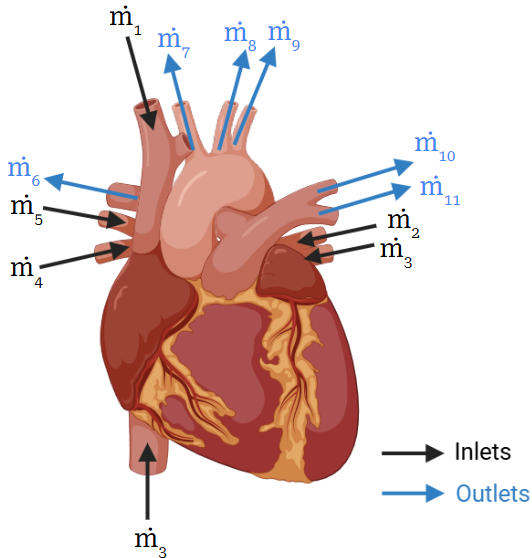
Biological systems often have multiple inlets and outlets (e.g. heart illustrated above). In an open, nonreacting, steady state system with multiple inlets and outlets, the total mass flow rate of every inlet must equal the total mass flow rate of every outlet:
where
- \( \dot{m_{i}} \) = Mass flow rate of inlet stream i
- \( \dot{m_{j}} \) = Mass flow rate of outlet stream j
Multicomponent Mixtures
Consider systems with mass entering and leaving in streams. Each chemical species or compound, s, in each stream is associated with its species flow rate as \( \dot{n}_s \) (moles of s/time) or \( \dot{m}_s \) (mass of s/time]). The total flow rate of the stream, in either moles or mass, can be calculated by summing the individual species flows over all species s present in the stream:
An alternative way of representing a stream is to give its total flow, in rate of either moles or mass, together with the composition of the stream. Two convenient measures of composition of a species are the mass or weight fraction, \( w_s \), and the mole fraction, \( x_s \). All mass and mole fractions of all species s in a stream must sum to 1:
Where mass and mole fractions are related to mass and molar flow rates, respectively
and using the molecular weight according to
The differential conservation equations for systems containing multiple inlets and outlets can be extended to systems that contain multiple species in each stream. For open, nonreacting, steady-state systems, the following mass conservation equations are written for:
Species mass: \( \sum{\dot{m}_{in,s}}-\sum{\dot{m}_{out,s}}=0 \)
Species moles: \( \sum{\dot{n}_{in,s}}-\sum{\dot{n}_{out,s}}=0 \)
Element mass: \( \sum{\dot{m}_{in,e}}-\sum{\dot{m}_{out,e}}=0 \)
Element moles: \( \sum{\dot{n}_{in,e}}-\sum{\dot{n}_{out,e}}=0 \)
Dynamic Systems
In a dynamic system, the variables describing the system, such as temperature, pressure, or mass, change with respect to time. Consequently, the amount of an extensive property within the system may differ between its initial and final states, resulting in a nonzero accumulation term in the accounting equation.
Dynamic systems are commonly described using differential or integral accounting equations, which account for changes in an extensive property over time.
Systems with Chemical Reactions
When approaching a problem involving a chemical reaction, you must write out the reaction and balance the equation before moving any further into the problem. Stoichiometric balances and reaction rates must always be worked in units of moles or molecules.
The reaction rate (R) characterizes the extent to which a chemical reaction proceeds. Reaction rate is expressed in moles or moles/time.
R is a constant for a stoichiometric equation and is not tied to a specific species and/or compound in a reacting system. R may be given, deduced, or calculated using the following:
or
The fractional conversion (f) of a reactant is the fraction of reactant s that reacts in the system relative to the total amount of s introduced into the system.
Finally, the limiting reactant is mathematically defined as the minimum of the following expression for all species in the system.
Learn More
Need more explanation? See more content in these references.
This content has been adapted from multiple sources including:
- A. Saterbak, K. San, and L. McIntire, (2018). Bioengineering Fundamentals, 2nd Edition.
- Heat, F. O., & Incropera, M. T. F. P. (2001). Fundamentals Of Heat And Mass Transfer.
- Rubenstein, David A, Wei Yin, and Mary D Frame. (2015). Biofluid Mechanics : An Introduction to Fluid Mechanics, Macrocirculation, and Microcirculation, 2nd Edition.