Porous Media Flow
Porous media flow can be describes as the bulk movement of a fluid in a porous media due to hydraulic forces.
Darcy's Law
Porous mediums can be approximated as a bundle of tubes of varying diameter, embedded within a solid matrix. Movement of liquid in a porous material is described by Darcy's Law:
- \( n^v \) = volumetric flux (volume/area · time) \( \left[\frac{m^{3}}{m^{2} s}\right] = \left[\frac{m}{s}\right] \)
- \( \mathcal{H} \) = hydraulic potential \( [m] \)
- \( s \) = distance along the flow path \( [m] \)
- \( K \) = hydraulic conductivity \( \left[\frac{m}{s}\right] \)
Hydraulic Potential
The hydraulic (water) potential \( \mathcal{H} \) drives flow, and is defined as:
- \( h \) = pressure (hydrostatic or pneumatic) and matrix potential — physical forces which bind water to the porous matrix; attractive force between liquid and solid phases \( [m] \)
- \( z \) = gravitational potential due to difference in depth in the vertical direction (i.e., from surface), in the direction of gravity \( [m] \)
Hydraulic Conductivity
Hydraulic conductivity \( K \) describes the ease with which a fluid can be transported through a porous matrix — it is the ratio of volumetric flux to the hydraulic gradient causing the flow. It depends on properties of both the solid matrix (pore size distribution, shape of pores, porosity, tortuosity) and the fluid (density, viscosity):
- \( \rho \) = fluid density \( [\frac{kg}{m^3}] \)
- \( g \) = acceleration due to gravity \( [\frac{m}{s^2}] \)
- \( \mu \) = fluid viscosity \( [\frac{kg}{m s}] \)
- \( \tau \) = tortuosity — how twisted or complicated the flow path is (approximately 1–2 for soils) \( [Dimensionless] \)
- \( \Delta\beta_i \) = volume fraction of pores with radius \( r_i \) (area fraction, 0–1), defined as \( \Delta\beta_i = \frac{\omega_i \pi r_i^2}{A} \) where \( \omega_i \) is the number of pores in the \( i^\text{th} \) pore size class with radius \( r_i \) \( [Dimensionless] \)
- \( r_i \) = radius of pores in size class \( i \) \( [m] \)
The sole effect of the matrix properties can be isolated as the permeability (\( k \)):
separating the effect of the matrix (captured in \( k \)) from the effect of the fluid properties (\( \rho \), \( \mu \)).
Porosity and Flux
Retention of water in a porous medium results from attractive forces between the solid and liquid phases.
Volumetric porosity (\( \phi \)) is the ratio of the volume of void space (pore volume) to the bulk volume of a porous medium. Average volumetric porosity is considered the same as average areal porosity at a cross section of the material:
Volumetric flux (\( n^v \)) is sometimes called "Darcy velocity", but it is not the true average velocity through the cross-sectional area. The true average velocity through the pores is much higher than that through the medium (solid matrix):
The average velocity is a vector with direction and magnitude.
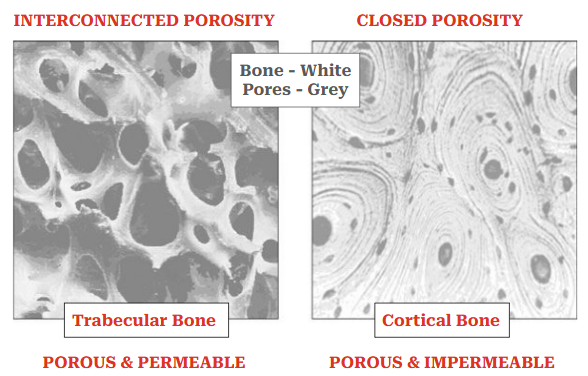
Heads Up!
Permeability and porosity are related intrinsic properties, but are not the same thing! Porosity is a property that designates a percentage of "empty" or "open" air space related to the volume of the porous material, which can store water. Permeability tells us how easily or quickly a fluid can move through a porous solid; a high permeability suggests that water can flow through interconnected pore spaces
Capillary Flow
Capillary flow describes capillary action (flow of liquid through a narrow space) within a porous solid medium. It is the balance between the relative attraction of the molecules of the fluid for each other (liquid-liquid) and for those of the surface (liquid-solid).
When liquid-solid forces are stronger, the liquid "climbs" against gravity (and other forces). This phenomena, called capillary rise, equates hydrostatic pressure \( P = \rho g h \) and capillary action pressure \( \frac{2\gamma}{r} \) to yield:
- \( h \) = height of the column or capillary \( [m] \)
- \( \gamma \) = water surface tension \( \left[\frac{N}{m}\right] \) (look up values)
- \( \rho \) = fluid density \( \left[\frac{kg}{m^3}\right] \)
- \( g \) = gravitational acceleration \( \left[\frac{m}{s^2}\right] \)
- \( r \) = radius of tube \( [m] \)
Capillary rise increases significantly as tube radius decreases. If the tube diameter is sufficiently narrow, liquid is "propelled" upward by the combination of surface tension and liquid-surface adhesive forces.
Unsaturated Flow
Recall that in a porous solid, capillarity causes liquid to be attracted more strongly when there is less of it (i.e., at lower concentration); causing liquid to flow across its concentration gradient. In unsaturated environments, the difference in negative pressures (matric potential) drives flow instead.
Unsaturated flow is mathematically similarly to molecular diffusion, and can be modeled as:
where
- \( D_{cap} \) = capillary diffusivity; material-specific \( [\frac{m^2}{s}] \)
- \( c \) = water concentration \( [dimensionless] \)
- \( s \) = flow path \( [m] \)
Osmotic Flow
Osmosis is the transport of a solvent from low to high solute concentration through a semi-permeable membrane. The porous structure allows passage of solvent but not the solute/medium, until a hydraulic pressure (\( \Pi \)) develops to oppose the osmotic flow. Osmosis occurs in the direction of reducing the solute concentration gradient (i.e., equalizing concentration) — for example, water flowing across cell membranes.
The relationship between hydraulic pressure and solute concentration is described by Van't Hoff law:
- \( \Pi \) = hydraulic or osmotic pressure \( [\frac{kg}{ms^2}] \)
- \( c \) = total concentration of the solute \( [\frac{mol}{m^3}] \)
- \( T \) = absolute temperature \( [K] \)
- \( R \) = gas constant \( \left[\frac{J}{mol \cdot K}\right] \)